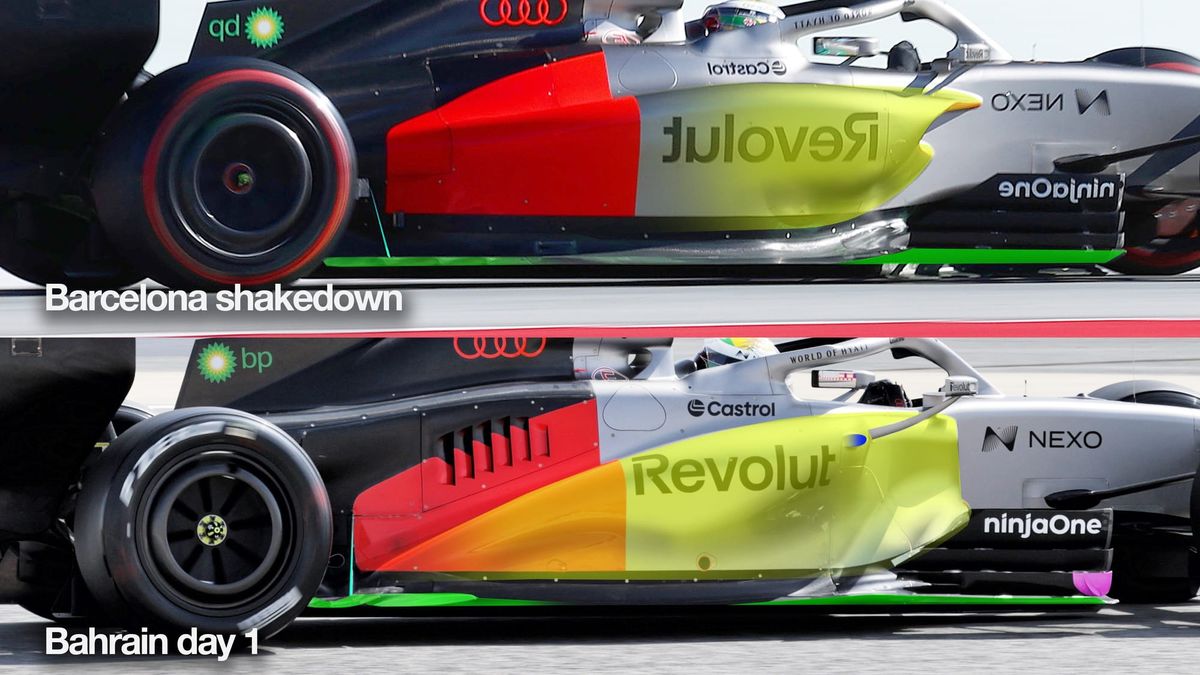
As the first Formula 1 team to take its 2026 car on the track, Audi has made significant impressions with its initial performance upgrades. Notably, the Bahrain pre-season test revealed striking improvements from the initial behind-closed-doors Barcelona shakedown.
"The difference between what it ran in the behind-closed-doors Barcelona shakedown and this first Bahrain pre-season test is dramatic," said Gary Anderson, an analyst and veteran engineer. Such changes often mark the evolution of new designs in Formula 1.
> "The difference between what it ran in the behind-closed-doors Barcelona shakedown and this first Bahrain pre-season test is dramatic,"

Team Dynamics
Among the most visible alterations to the car are its revamped sidepods and front wing. The new design suggests a shift in aerodynamic strategy, which is common as teams refine their approach leading up to a season.
Related: [Audi F1 Introduces Innovative Sidepods in Bahrain Pre-Season Test](/article/audi-f1-introduces-innovative-sidepods-in-bahrain-pre-season-test)
When comparing the front wing performance, Anderson mentioned significant enhancements. "This comparison shows the Barcelona front wing and the Bahrain version." He specifically pointed out changes made to the endplate, noting, "Audi seems to have added a small turning vane to the rear of the front wing endplate lower tunnel."
> " He specifically pointed out changes made to the endplate, noting, "

Impact and Legacy
Impact and Legacy
Impact and Legacy
These tweaks not only impact airflow but also increase aerodynamic efficiency. The alterations, such as the new profile on the rear element of the wing, create more 'outwash,' a desirable effect that helps with downforce. Anderson assessed this adaptation: "Both of these changes achieve more of that dreaded outwash."
Related: [Audi's Innovative Bodywork Sparks Conversations at Bahrain Testing](/article/audis-innovative-bodywork-sparks-conversations-at-bahrain-testing)
Discussing the car's aerodynamic features, Anderson brought attention to the actuators, which he speculated could be significant. "I am assuming that these two components are the front wing actuators," he noted, suggesting that they enable dynamic adjustments crucial for optimizing straight-line speed.
> "I am assuming that these two components are the front wing actuators,"
Impact and Legacy
As teams grapple with airflow dynamics, the visual differences between the Barcelona and Bahrain versions of the car highlight dramatic shifts in performance trajectories. "The lower shot from Bahrain shows Audi has now headed off on a tangent... will have a major influence on the airflow structure around the sidepods," explained Anderson, drawing parallels to Mercedes's historical zero-sidepod layout.
Additionally, Audi's design embraces a more swept-down sidepod top surface. This modification aims to enhance airflow towards the rear of the car, benefiting the rear wing and diffuser performance. Anderson remarked, "This will help get more airflow down into the back of the car, improving the performance."
With active aerodynamics set to play a pivotal role in 2026, he emphasized that the airflow variations would necessitate continuous adjustments. "It’s not just about optimizing the car for a small front wing angle variation for different circuits; this large front wing angle variation will be happening each lap," he stated.
> "It’s not just about optimizing the car for a small front wing angle variation for different circuits; this large front wing angle variation will be happening each lap,"
The integration of bargeboards, designed to manage airflow, is another strategic change. Anderson highlighted how these components interact with the front tyres, noting their role in creating a low-pressure area. "Basically, the fact the bargeboards... will create a low-pressure area behind them," he explained, detailing a sophisticated airflow management strategy.
The intricacies of the new design do not end there; cooling mechanisms are another vital aspect addressed in this iteration. Anderson observed, "I’m not sure where this will lead to, but it’s just part of the detail required to manage the overall cooling required for these cars."
Team Dynamics
As the team progresses through its development, the tight packaging of the car's components signifies advancements in engineering. Features like the mirror mounts showcase the technological leaps made in recent decades. "It’s this sort of detail on these current cars that we couldn't even have imagined about 30 years ago," said Anderson.
> "It’s this sort of detail on these current cars that we couldn't even have imagined about 30 years ago,"
In conclusion, Audi's upgraded car showcases a blend of innovation and refinement. With a focus on airflow management and aerodynamic performance, the team is well-positioned to make a substantial impact in the 2026 Formula 1 season, as they continue to build on these foundational improvements.
Source: the-race.com