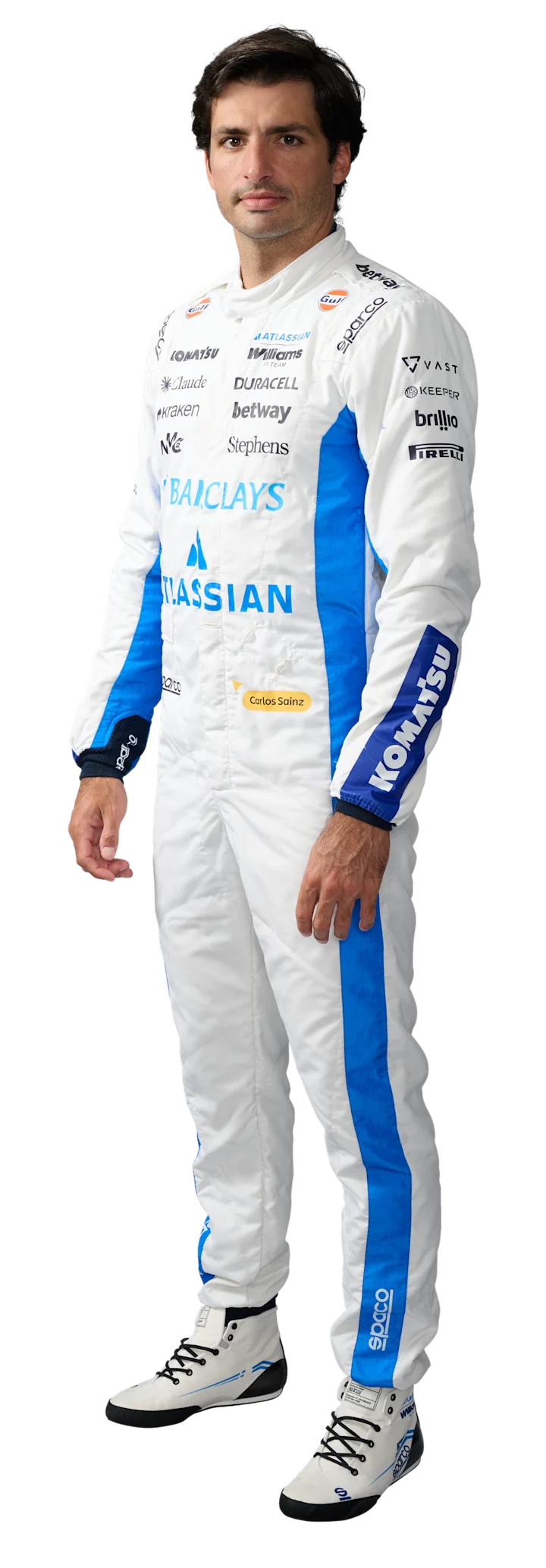
Carlos Sainz has put a specific geographical warning on Formula 1's 2026 power-clipping problem, telling the Away We Go Podcast that what has already caused uncomfortable moments on permanent circuits could become genuinely dangerous at a street race.
The Williams driver was asked about the sudden-speed-drop phenomenon that has defined the opening rounds of the 2026 season — a quirk of the new power units in which a car running out of deployed electrical energy can lose up to 50km/h in a heartbeat. Sainz's answer explicitly connected the issue to the circuits where there is nowhere to run.
"If this happened in Baku or a street circuit Singapore where there wasn't a runoff area, you know, where someone would have just gone into the back of somebody else and maybe a car's fle... like it could have been a really different outcome."
His voice caught mid-sentence on the word "fle", the unfinished fragment pointing towards the scenario every driver and team principal is now thinking about: a mid-pack collision with no asphalt buffer, barrier on one side, car on the other, and fire.
The warning follows Ollie Bearman's 50G crash at Suzuka, an accident triggered by the same speed-differential mechanism Sainz is describing. On a track as open as Suzuka, Bearman walked away. On Baku's approach to Turn 1, or between the concrete walls from Turn 5 to Turn 6 in Singapore, the equivalent incident is not survivable in the same way.
The F1 calendar plays directly into Sainz's point. After the Miami Grand Prix, the season hits a run that includes two classic street races — Monaco and Montreal — before arriving at Baku in September and Singapore in October. If the 2026 regulations are still producing these differentials by then, the sport is staring at a safety exposure on some of its most commercially valuable weekends.
The host of Away We Go explained the underlying mechanism in blunt terms: the 2026 cars do not ease off their electric deployment, they fall off it. That means a driver following a car that has just run out of harvested energy is suddenly approaching a moving chicane that has braked for them, without braking.
Sainz's intervention is significant because of who he is and what he is not. He is not a YouTuber framing a provocative video. He is not Max Verstappen, who has been critical of the 2026 package since 2023. He is a three-time Grand Prix winner who moved to Williams specifically to rebuild and who is taken seriously by race directors and engineers as a driver-rep voice. When he names circuits, the FIA's safety department listens.
Sainz's view dovetails with McLaren team principal Andrea Stella's repeated warnings to the paddock that the speed-differential issue needs urgent attention before "a serious accident" occurs. THE RACE has reported that the FIA is working through six proposed fixes to the 2026 rules before Miami.
The unspoken deadline in Sainz's comments is the arrival of the first street circuit that is not Monaco. Monaco's speeds are low enough that a clipping incident there is a scrape, not a fireball. Baku, with its long flat-out run down the harbour front, is the one nobody in the paddock wants to see run under the current regulation as-is.
Source: youtube.com