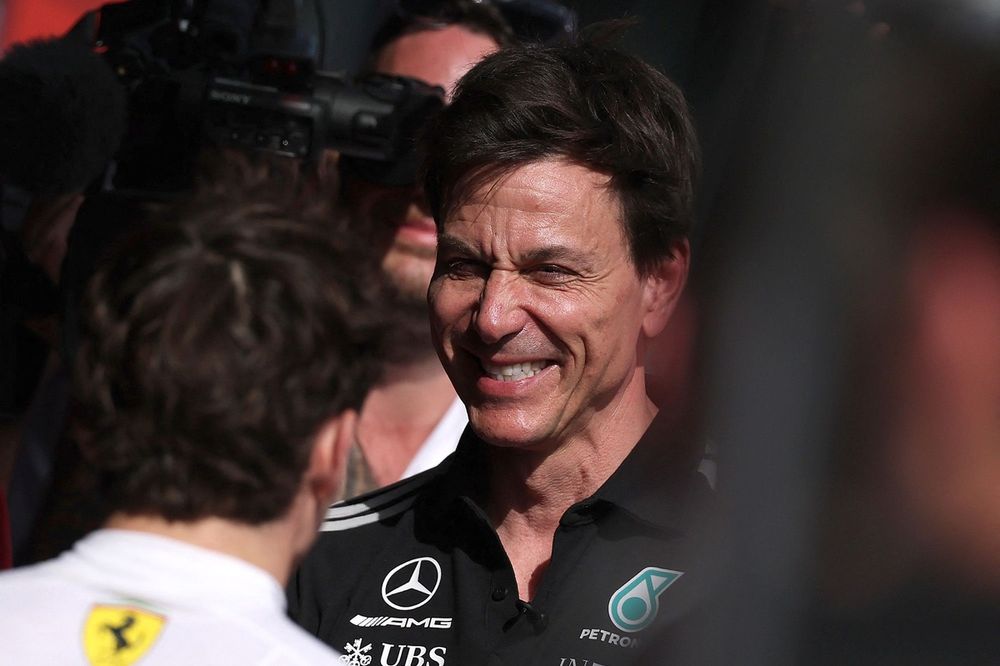
Toto Wolff was asked, in the green room moments after the first-ever Canadian Grand Prix sprint, whether watching his two Mercedes drivers race each other for real had been uncomfortable. His response was not the one Mercedes' communications playbook would have written for him.
"It was great cinema, no?" Wolff said. "Tough fighting not only between our two, but also with Lando and further back. Enjoyed watching it."
The cinema in question: George Russell defending into Turn 1 on lap seven of the sprint, Andrea Kimi Antonelli sweeping around the outside, then running off the road on the exit. On the same lap, Antonelli lunged again into the next chicane, ran across the marbles, and lost a position to McLaren's Lando Norris.
It cost Mercedes a P2 finish to a car that had been three seconds behind them. Wolff acknowledged that openly.
"I think you can see how quickly it goes," he said. "You create a gap with two cars and then you start to fight a bit. And you can lose a race. If that goes longer and a bit unlucky for us and it's the Grand Prix, Norris may well win."
The flashpoint of the broadcast — beyond the on-track move itself — had been Wolff cutting in on the radio to tell Antonelli to stop moaning about a penalty for his own teammate. Asked directly about the intent behind the message, Wolff was unapologetic.
"You know, we don't want to start with race five and have headlines like 'Star Wars' or 'this is escalating' because it's not," Wolff said. "It's in the emotion and he's a young driver and I think George would have probably done the same. So we just need to see how we handle it."
What he made clear is that the radio call was the start of a Mercedes process, not the end of it. The post-race debrief, by Wolff's framing, was about establishing a framework for what comes next — not punishing what just happened.
"I really enjoyed these moments because it allows us to learn and to say, 'OK, what are we doing with this situation? How are we handling that in the future?'" Wolff said. "Because you don't want to lose a race, you don't want to crash into each other. And sometimes it needs a little moment to remind ourselves what our objectives are."
"This is not particularly against one or the other," he added, "but there's a framework that we want to establish, and I'd rather have it in a sprint race where it's not about a lot of points than in the main race."
The numbers that frame Wolff's calm: Antonelli leads Russell by 18 points in the championship after the sprint result. Both drivers have championship-winning cars. Both have just sent Mercedes a very clear message about what kind of fight Sunday's Grand Prix could become.
Russell put a Mercedes on pole for the Grand Prix on Saturday evening, with Antonelli alongside him on the front row again, 0.068 seconds slower for the second day in a row. Wolff's stated preference is to let them race. The first big test of that policy is Sunday's start into Turn 1.
Source: youtube.com