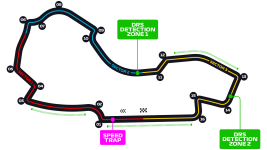
Albert Park Circuit
Melbourne, Australia
Capacity
80,000
Lap Record
1:19.813
Track Length
5.278 km
Race Laps
58
About
The sun glints off the waters of Albert Park Lake, a serene inner-city Melbourne backdrop belying the ferocious energy about to be unleashed. This is the Albert Park Circuit, a temporary street track that has forged a permanent place in the heart of the Formula 1 calendar as the traditional, and often spectacular, season opener. Its 5.278 kilometres of public roads, transformed once a year into a high-speed theatre of motorsport, demand a unique blend of precision and bravery, a challenge that has produced some of the sport’s most memorable moments since its reintroduction in 1996.
The circuit’s history is one of revival. While the Australian Grand Prix found a home in Adelaide from 1985 to 1995, the move to Melbourne’s Albert Park was a statement of intent, bringing the glamour of F1 to the heart of a sporting-mad city. The layout, designed by Ron Walker and modified by the FIA’s Charlie Whiting, utilised the existing roads around the lake, but with crucial modifications to create a track that was far faster and more demanding than a typical street circuit. The result was a hybrid: it possesses the punishing, close-confinement walls of a Monaco or a Baku, but the flowing, medium-to-high-speed nature of a permanent road course. This duality is its defining characteristic and its greatest trick.
A lap of Albert Park is a relentless technical examination. The charge to Turn 1 is a frantic dash where opening-lap fortunes are made and shattered, a sharp right-hander that immediately punishes any lapse in concentration. The rhythm then builds through the flowing esses of Turns 2 and 3, a complex that requires a perfect car balance and rewards the bold. The first real overtaking opportunity arrives at Turn 3, but it is a move fraught with risk. The track then snakes around the lake’s eastern shore, through the challenging right-hand kink of Turn 6 and into the heavy braking zone of the tight left-hander at Turn 9. The exit here is vital for the blast down to the circuit’s most iconic sequence: the high-speed swerves through Turns 11 and 12. This is a stomach-churning, commitment-heavy section taken flat-out in a modern F1 car, a true test of a driver’s nerve as the walls flash by in a blur. The final sector offers a brief respite before the final two corners, a slow right-left chicane that demands good traction to fire onto the pit straight, completing a lap that leaves no room for error.
This unforgiving nature has written Albert Park into F1 folklore. It was here in 1996 that a fresh-faced Jacques Villeneuve announced his world title credentials by taking pole, only for his Williams teammate Damon Hill to secure a popular victory. In 2002, a young Mark Webber sent the home crowd into a frenzy on his debut, miraculously dragging his minnow Minardi to a fifth-place finish in a race of attrition. The circuit has also witnessed controversy and drama, such as the infamous first-corner pile-up in 2002 that saw half the field eliminated, and the 2009 event where a diffuser controversy erupted, setting the tone for a tumultuous season. More recently, the 2023 race provided a spectacle, with Max Verstappen and Lewis Hamilton engaging in a thrilling duel after a late red flag, a dramatic reminder of the circuit’s capacity for unpredictability.
Beyond the on-track action, the atmosphere at Albert Park is electric. With a capacity of 80,000, the grandstands and parkland grounds are packed with knowledgeable and passionate fans, creating a festival-like ambiance unique in Formula 1. The Australian fans, known for their enthusiastic and respectful appreciation of all competitors, generate a palpable buzz that energises the entire paddock. The sight of fans picnicking on the grassy banks, the sound of support for local heroes like Daniel Ricciardo and Oscar Piastri, and the general carnival atmosphere make the Australian Grand Prix an event, not just a race. It is a celebration of speed set against a stunning urban landscape.
Following a significant redesign in 2022 to facilitate better racing, the track’s character was subtly enhanced. Wider sections and reprofiled corners aimed to increase overtaking opportunities without sacrificing the fundamental challenge that makes Albert Park so revered. The result is a modernised classic, a track that retains its flowing, high-speed DNA but with an added strategic dimension. As the cars line up on the grid, the shimmering lake a silent witness, the Albert Park Circuit stands ready. It is a beautiful, brutal, and captivating way to begin the Formula 1 season, a track that respects history while constantly forging new legends under the bright Australian sun.
Race History
Australian Grand Prix
2026 Season
8 Mar 2026
completedAustralian Grand Prix Qualifying
2026 Season
6 Mar 2026
completedAustralian Grand Prix Practice 2
2026 Season
5 Mar 2026
completedAustralian Grand Prix Practice 1
2026 Season
5 Mar 2026
completedAustralia Grand Prix
2025 Season
16 Mar 2025
completedAustralia Grand Prix
2025 Season
16 Mar 2025
completedAustralian Grand Prix
2025 Season
15 Mar 2025
completedAustralia Grand Prix
2025 Season
15 Mar 2025
completedAustralia Grand Prix
2025 Season
15 Mar 2025
completedAustralia Grand Prix
2025 Season
15 Mar 2025
completed