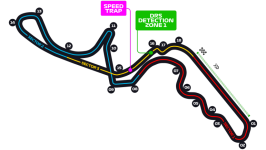
Suzuka International Racing Course
Suzuka, Japan
Capacity
155,000
Lap Record
1:30.965
Track Length
5.807 Kms
Race Laps
53
About
The Suzuka International Racing Course stands as a sacred ground in the world of motorsport, a unique and timeless test of driver skill and machine integrity that has written itself into the very fabric of Formula 1 history. Owned by the Honda Motor Company and designed by Dutchman John Hugenholtz in 1962, its initial purpose was as a test track for Honda employees. This origin story belies the fearsome challenge it would later pose to the world’s greatest racing drivers, evolving into one of the most revered and demanding circuits on the planet. Its figure-of-eight layout, a rarity in top-tier motorsport, is not merely a gimmick but the foundation of its flowing, relentless character, a 5.807-kilometer ribbon of asphalt that demands absolute commitment and precision.
The circuit’s layout is a masterpiece of engineering, a relentless sequence of corners that flow into one another with a natural rhythm that punishes any error without mercy. The journey begins with a burst of acceleration towards the infamous first corner, a tightening right-hander that has witnessed countless opening-lap incidents. But Suzuka’s true soul is revealed in the esses of the first sector, a dizzying, high-speed slalom through Turns 3 to 7 that requires a hypnotic rhythm and immense courage. The car must be danced through these left-right flickers, the slightest misjudgment sending a driver spearing into the tyre barriers. This dizzying sequence culminates in the Degner curves, a pair of deceptively quick right-handers where the track falls away on exit, a corner complex that has ended the hopes of many a championship contender. After the slow-speed hairpin, the track plunges into the darkness under the bridge and emerges into the breathtaking 130R, one of the last true great corners in Formula 1. Taken flat-out in a modern F1 car, it is a monumental test of aerodynamic downforce and nerve, a left-handed sweep that presses the driver into their seat before they must immediately brake for the final chicane. This last technical section, with its aggressive kerbs, is a brutal final test before the cars blast across the finish line and begin another lap of this magnificent trial.
Suzuka’s place in Formula 1 legend is cemented not just by its design but by the drama it has hosted. It is the stage where World Championships are so often decided, a fittingly demanding arena for the ultimate prize. The circuit is forever linked with the fierce rivalry between Ayrton Senna and Alain Prost, most infamously in 1989 when the two McLaren teammates collided at the final chicane, handing the title to Prost in the most controversial of circumstances. A year later, Senna extracted his revenge in a chillingly deliberate first-corner collision that sealed his second championship. More recently, the circuit has been the backdrop for titanic battles between drivers like Michael Schumacher and Mika Häkkinen, and Sebastian Vettel and Fernando Alonso. The sight of a driver conquering Suzuka, as Schumacher did so often, is a true measure of their greatness. The 1994 Japanese Grand Prix, held under a somber sky, saw Damon Hill produce a drive of immense pressure to keep his title hopes alive, while in 2005, a stunning late move around the outside of Fisichella at the 130R by Kimi Räikkönen on the final lap became an instant classic, a moment of pure, audacious skill that only this track could inspire.
Beyond the asphalt and the history, the atmosphere at Suzuka is uniquely Japanese and utterly electrifying. With a capacity of 155,000, the venue swells with a knowledgeable and respectful crowd, their passion expressed not through raucous noise but through a deep, appreciative silence during qualifying and an orderly, enthusiastic presence. The sight of the dedicated fans meticulously cleaning their grandstand section after the race is a testament to the culture of respect that permeates the event. The circuit itself is nestled within a sprawling amusement park complex, adding a surreal, festive backdrop to the high-stakes drama unfolding on the track. The climb to the grandstands reveals the circuit’s undulating nature, and from the top of the ferris wheel, one can truly appreciate the genius of its figure-of-eight layout, seeing the cars snake through the esses far below before disappearing under the cross-over point. This blend of cutting-edge competition and traditional Japanese hospitality creates an experience unlike any other on the calendar. Suzuka is more than a track; it is a pilgrimage. It is a physical manifestation of Formula 1’s sporting challenge, a place where legacy is forged, and where every corner tells a story of triumph, heartbreak, and sheer brilliance. It remains, unequivocally, one of the greatest circuits ever created.
Race History
Japan Grand Prix
2026 Season
29 Mar 2026
completedJapan Grand Prix
2025 Season
6 Apr 2025
completedJapan Grand Prix
2025 Season
6 Apr 2025
completedJapan Grand Prix
2025 Season
5 Apr 2025
completedJapan Grand Prix
2025 Season
5 Apr 2025
completedJapan Grand Prix
2025 Season
5 Apr 2025
completedJapan Grand Prix
2025 Season
5 Apr 2025
completedJapan Grand Prix
2025 Season
4 Apr 2025
completedJapan Grand Prix
2025 Season
4 Apr 2025
completedJapanese Grand Prix Free Practice 2
2025 Season
3 Apr 2025
completed