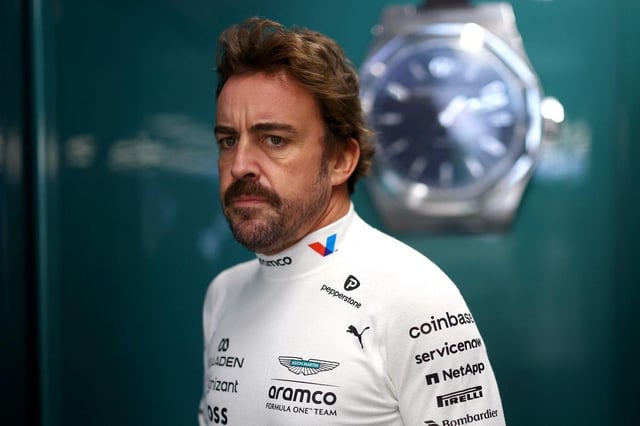
Fernando Alonso has rarely been accused of softening his views as he has aged. On Wednesday in Montreal, the two-time world champion took aim at the foundations of the modern Formula 1 product, and pulled no punches doing it.
In his assessment, F1 has spent more than a decade chasing something that is not really racing at all.
"Unfortunately, we had this period from 2014 with the turbo era, and now even more, that we lost nearly one decade or even more of pure racing," Alonso said.
The attack was directed squarely at the hybrid power unit and the way it shapes wheel-to-wheel combat. Alonso, who has driven through the V10 era, the V8 era, the early V6 hybrids and now the 2026 ground-effect cars, was asked about the changes coming in 2027 and whether they will fix the issues fans have been complaining about. His answer suggested the diagnosis is being missed.
"It will not be overtaking, it's just an avoiding action," he said.
Alonso then explained, in granular technical language, what he means in practice. The argument is that modern "overtakes" are largely electrical accidents – a function of when one car runs out of battery deployment relative to another – rather than a duel of braking points, exit traction and driver bravery.
"When you have more battery than the others, the other ones clip, so they reduce 500 horsepower," Alonso said. "Then you have 500 horsepower more than the others, you take an avoiding action, and then you overtake a car."
That is a remarkable thing for a driver to say out loud at the start of a race weekend. It is not a complaint about the size of the cars or the weight or the noise – the usual targets. It is a complaint that the sport has accidentally engineered overtakes into a binary energy calculation, where the result is decided before the cars even meet.
Whether the 2027 tweak – the move toward roughly a 60-40 combustion-to-electrical split, away from the 50-50 of the 2026 rules – will solve that, Alonso flatly does not believe.
"Waiting," he said when asked if the changes would fix things. "The DNA of these power units will always be the same. And it will always reward going slow in the corners."
That last line is the most damning. "Reward going slow in the corners" is shorthand for the energy-recovery logic of the hybrid era: the more you brake hard and the more you slow down, the more energy you can harvest and redeploy. It is the antithesis of how Alonso, a driver schooled in maximising apex speed, wants the sport to work. For him, the system is structurally upside-down, and changing the split between combustion and battery is rearranging deckchairs on the same ship.
The broader context is that Alonso is in the autumn of his F1 career, sitting at Aston Martin and watching the Honda partnership ramp up in 2026. His on-track frustrations this season have been documented. But his criticism here is not parochial. It is not aimed at his own car, or his own team. It is aimed at the formula itself.
And it is in pointed contrast to the more diplomatic line offered by Max Verstappen, who on the same day called the 2027 engine tweak "very positive" and a reason he can see himself staying in F1. Where Verstappen sees a course correction, Alonso sees a sport still walking in the wrong direction.
The verdict from the most experienced racer on the current grid is now on the record. F1 has, in his view, lost a decade. And the 2027 fix is not going to bring it back.
Source: newsformula.one