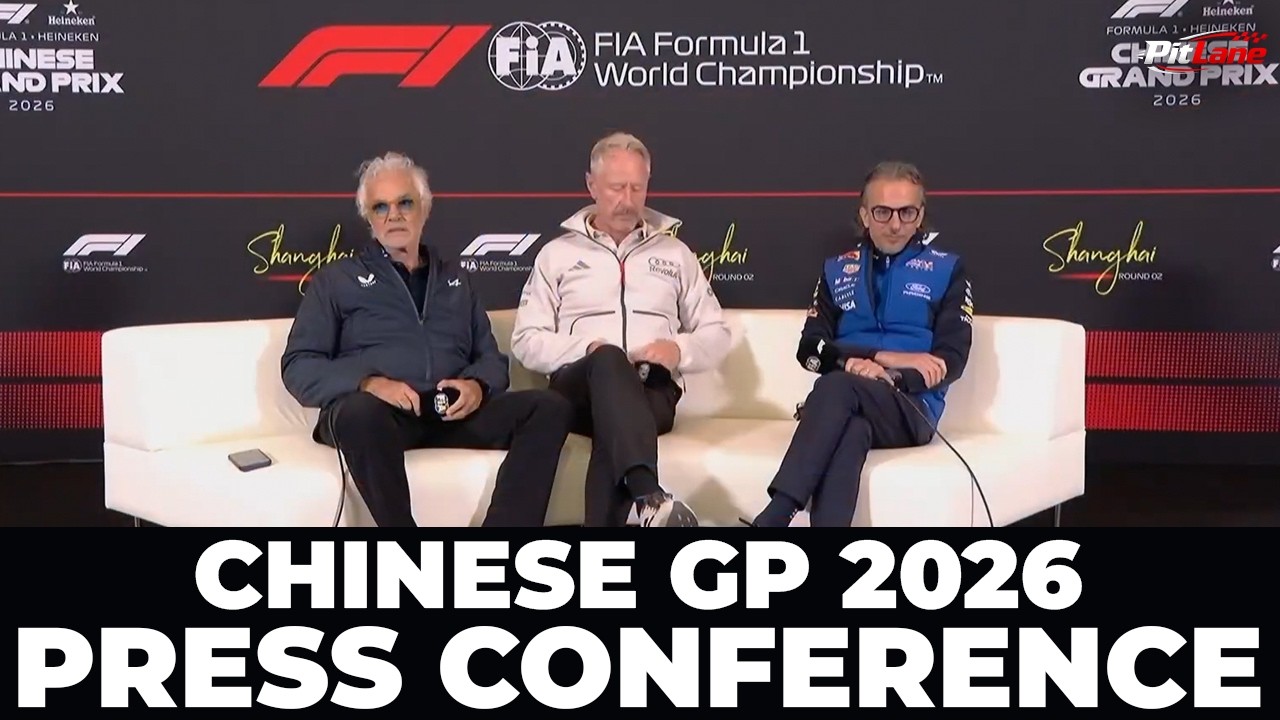
By the time Audi confirmed Jonathan Wheatley's departure with immediate effect in early April, the team principal's last serious public briefing on the project was already being re-read. The interview, given in Shanghai before the Chinese Grand Prix, did not read like the words of a man on the way out. It read like a measured, slightly resigned diagnosis of why a brand-new Audi works team would not be challenging at the front for a while - and it now sits as the cleanest contemporary account of the problem his successor will inherit.
The most quoted line was about scale. Wheatley was asked whether Audi could realistically close the gap to Mercedes, and he reached for a piece of arithmetic that has since become the public shorthand for the team's first-year reality.
"As a PU manufacturer, we only have two cars with an Audi PU in them, and Mercedes have eight cars. They're learning at a much faster rate as well. So we're not underestimating the challenge we have ahead of us."
The maths is not flattering. Mercedes power three customers - McLaren, Williams and Aston Martin - in addition to its works team. That gives the Brackley engine programme four times the on-track sample size that Audi has across qualifying and race runs. Under the 2026 regulations, where energy harvesting and deployment strategy is doing more of the lap-time work than the combustion side, that data advantage compounds quickly.
Wheatley refused to spin around it. He used a separate answer to identify powertrain development as the team's main 2026 priority, in language that read like a deliberate signal to the FIA and the wider paddock.
"It won't come as a surprise to anyone. It's a brand new chassis, brand new power unit. We've got some areas to make up, and especially our focus at the moment is on the powertrain development. That's clearly one of the areas that we've identified."
This was not the language of a project promising to leapfrog. It was a public statement that Audi's Hinwil chassis side and its Neuburg power unit programme were running on different timelines, with the engine side the slower of the two. That ordering of priorities has held in the way Audi has spent its development tokens since.
There was a quietly proud passage about the drivers. Wheatley used it to back Gabriel Bortoletto, the team's designated long-term project, and to praise the work-rate of both drivers across the winter.
"I've been encouraged with both drivers over the winter, recharging, coming back fully focused and absolutely embedded with their engineers, looking at every single area where you can get performance out of the team and out of the car."
The Brazilian rookie is the part of the project Audi most wanted to advertise. The team's calculus on Bortoletto was that, if the early years of the regulation cycle were going to be hard anyway, they should be hard with a driver pair that included a long-term anchor. Nico Hulkenberg's experience would steady the operation; Bortoletto's development would be the asset that paid out across 2027 and beyond.
Wheatley's final point - that the team would, eventually, be looking up the road and learning - has read since his exit as both a scouting report and a bequest. Audi's first-year ranking is not the project's measure. The project's measure is whether, by the time the data sample catches up with Mercedes', the chassis is ready to use it.
"They've done a great job and they've shown us what is possible, what's achievable at the moment. We're focused on our own performance. Internally, at some point, we're going to be looking up the road and we're going to be learning."
That is the inheritance Wheatley left. The team principal shortlist that emerged after his departure - including Christian Horner, Andreas Seidl and Guenther Steiner, with Allan McNish stepping in as racing director - tells you Audi understood the gravity of replacing him. The frameworks Wheatley laid out in Shanghai - eight engines versus two, powertrain ahead of chassis, rookies as long-term assets - are the ones any successor will have to either accept or rewrite.
The Drive Thru Penalty podcast was less generous about the manner of his exit, with one host suggesting that the 'personal reasons' framing was code for a richer offer elsewhere. Whether that proves true or not, the substance of Wheatley's last public Audi work is a clean structural read of the problem. It is, oddly, the most useful thing the team has published all year.
Source: youtube.com