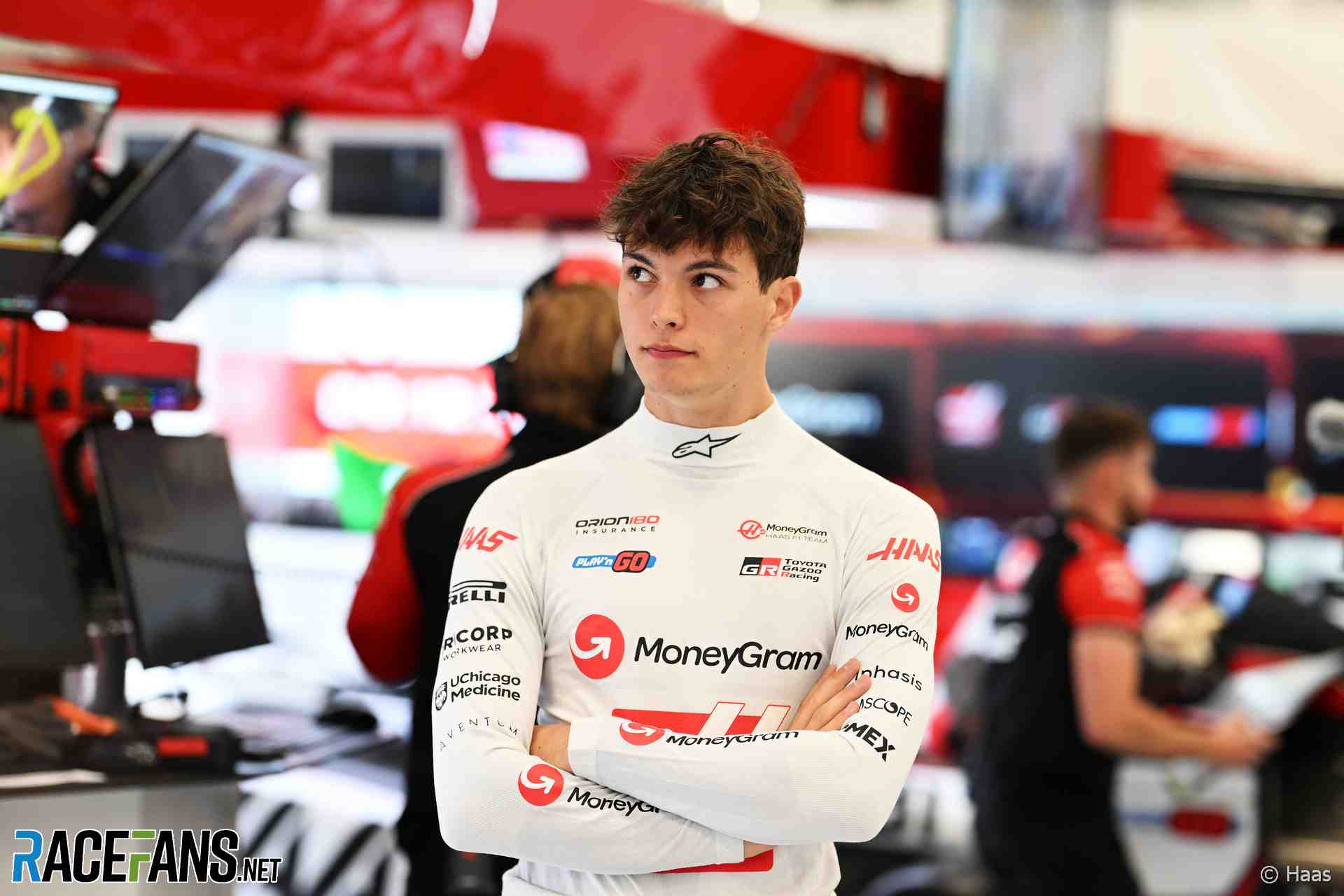
The official F1 sales pitch for the 2026 regulation reset has, since the rules were announced in 2023, leaned on one promise: cars will be easier to follow, easier to pass, and overtaking will be more interesting. Oliver Bearman, fresh from the season opener in Australia and with the engineering bandwidth of his Haas race engineers behind him, has now delivered a data point that quietly contradicts the entire pitch.
"Yeah, on one side, on this track the the overtaking delta is is like eight or nine-tenths. Last year DRS was six-tenths. This year the overtake mode" — and Bearman left the implication hanging.
The translation is brutal. To complete a pass under the 2026 manual override system, a chasing car needs to be roughly eight-to-nine tenths of a second per lap quicker than the car in front. Under the old DRS regime, the same operation was achievable with a six-tenth advantage. The on-track gap has not shrunk under the new rules. It has grown.
That is the inverse of what the FIA spent two years promoting. Stefano Domenicali's selling line has been about closer racing and a level field. Bearman's number is one of the first hard quantifications of how the on-track maths actually plays under the new regulations, and it lines up with what every driver complaining about super-clipping is also describing — the moment you actually try to overtake, you give up so much battery doing it that the move becomes self-defeating.
Lando Norris's frustration has framed the same arithmetic with more theatre.
"Why do you even try and overtake when you lose battery to to get past?" he asked after Suzuka, in a complaint quoted on the P1 with Matt & Tommy podcast.
The same broadcast had Tommy quietly compiling the consequences for the midfield: "We heard Lando's comments of like why do you even try and overtake when you lose battery to to get past." The answer, on a track like Albert Park, is that you don't.
Bearman knows what he's talking about. The Haas rookie is more than two months past the only on-track moment of 2026 that has truly scared the paddock — his 50G impact with the wall at Suzuka after Franco Colapinto, also caught out by an energy-clipping moment, dropped slowly into his line. The crash now anchors every discussion of the rules. Carlos Sainz's GPDA-aligned warning that the same incident at Baku, Singapore or Vegas would not have ended with a walking driver has set the safety stakes.
But Bearman's Albert Park observation is a different problem from the safety problem. The safety question is: how do we stop the closing-speed disparity from killing someone? The overtaking question is: have we, in trying to be cleverer than DRS, made the racing actually more boring?
Bearman's answer, in a number, is yes.
That number is now travelling. The F1 commentariat that championed 2026 is having to reconcile a fundamental contradiction — drivers report fun racing, fans report unpredictable Sundays, and the data quietly says overtaking moves are actually harder to land. Charles Leclerc's recent admission that he is "positively surprised" by the cars sits awkwardly next to Bearman's 8-9 tenths figure. Both can be true.
The FIA's six-point Miami rule package addresses the safety side of the equation more directly than the racing side. Increasing super-clipping power, reducing maximum deployment, and lowering qualifying energy limits will all flatten the deployment cliff that produced Bearman's own crash. None of them, on the engineering reading, particularly help the chasing car close the kind of 8-9 tenths gap Bearman is describing on a wide-open Albert Park.
The defining fight of the spring break, before Miami, may not be about the chassis or the power unit. It may be about whether the FIA acknowledges that an overtake mode designed to replace DRS has, on Bearman's numbers, actually made the cars harder to pass than the system it replaced.
Source: youtube.com