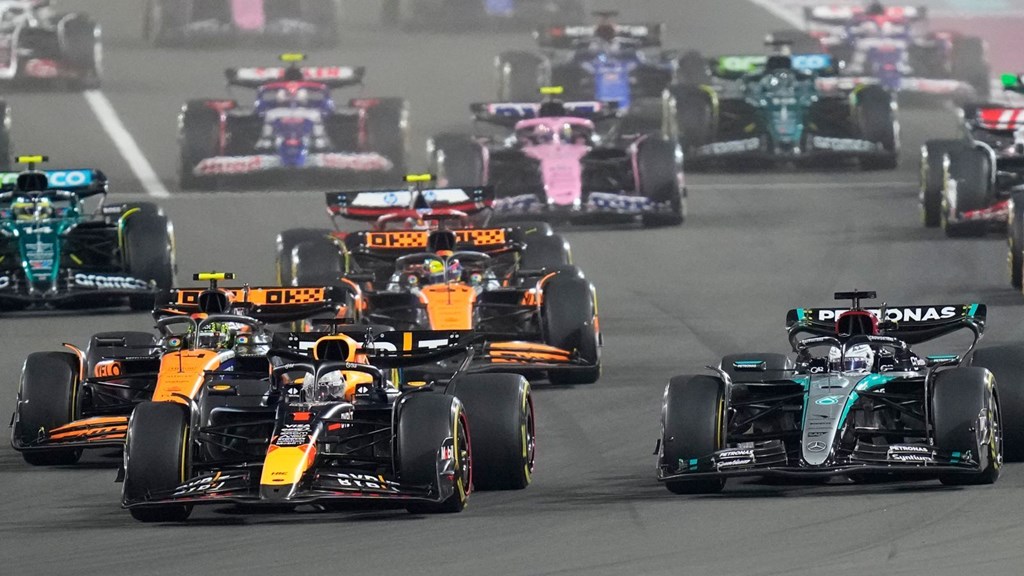
As Formula 1 arrives at the Lusail International Circuit for the penultimate round of the 2025 season, a specific tyre regulation has taken center stage alongside the championship battle. Pirelli has imposed strict limits on tyre usage that will fundamentally alter race strategy for all teams.
Each tyre set can complete a maximum of 25 laps cumulatively across the weekend's five track sessions. The only laps not counted toward these totals are those from pit lane to grid, formation laps, and circuits completed after the chequered flag in both Saturday's Sprint and Sunday's Grand Prix.
Pirelli will provide teams with precise lap counts for their remaining tyre sets ahead of the main event. The Italian manufacturer has brought its three hardest compounds—C1 (hard), C2 (medium), and C3 (soft)—to handle the demanding nature of the Lusail track. Teams begin the event with two sets of hard, four of medium, and six of soft tyres.
Sky Sports F1 analyst Bernie Collins, former head of race strategy at Aston Martin, explained the safety rationale behind the new regulation. "Qatar is a high-speed circuit that puts a lot of loads in the tyres," said Collins. "In 2023 we had quite aggressive peaks in the kerbs that were actually cutting the sidewalls of the tyres, which is obviously very dangerous due to the high-speed nature of the track."
While kerbs were reprofiled before last year's event, cooler than expected conditions created different challenges. "Last year we had much cooler conditions in Qatar than we expected and that allowed teams to complete a one-stop strategy because there was very little tyre degradation," Collins noted. "That combined with quite a long pit-loss time pushed people to complete a one-stop strategy and saw some tyres reach maximum wear level."
The extreme wear created safety concerns that prompted the new rules. "The outer surface had basically worn away and you are on the construction of the tyre," Collins explained. "Combined with the potential for the cuttings on the kerb when the tyre is very thin, that is what Pirelli are worried about. So wearing it to that very thin level, if you get a cut then it's very dangerous."
The 25-lap limit was established based on data from last year's event. "That's why they have brought in this limit of 25 laps based on the 35 laps that they had seen people complete last year," Collins added.
This regulation will dramatically alter how teams approach the 57-lap race. "The biggest thing that it will change is that it forces all teams into a two-stop strategy," Collins stated. "But with 25 laps and only a 57-lap race there is good variability in when you can stop. Unlike two years ago, I think there is a lot of variability possible in strategy."
Teams must now carefully manage their tyre allocation throughout practice and qualifying to ensure they have sufficient sets available for the mandatory two stops. The rule eliminates any possibility of a one-stop strategy that might have been viable under different conditions.
Collins emphasized how this changes preparation approaches: "It will change how people use tyres and what tyres they save for the race. If the track temperature is cool enough it could have been a one-stop race again without this limitation so therefore teams are going to need another set for the race than they would otherwise have done."
The Qatar Grand Prix takes on added significance as the championship battle reaches its climax, with the tyre regulation adding another strategic layer to the competition. Teams must balance aggressive racing with careful tyre management to avoid penalties or being forced into additional stops beyond the mandated two.
With the championship potentially decided this weekend, all eyes will be on how teams adapt their strategies to the new tyre regulations while fighting for crucial points in both the drivers' and constructors' championships.
Source: skysports.com