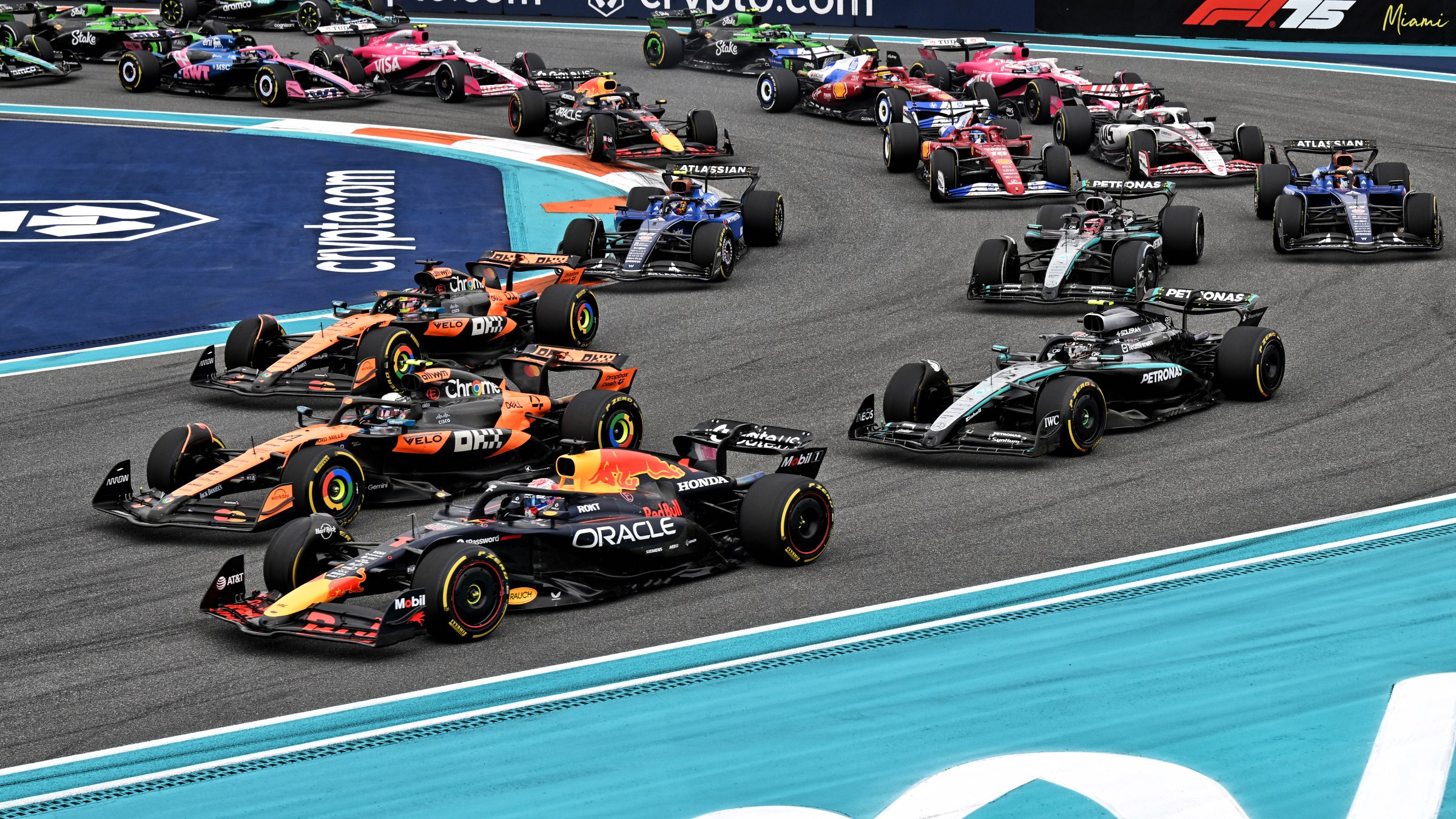
The 2025 Miami Grand Prix presented Formula 1 teams with one of the season's most challenging tests, combining high temperatures, a slippery surface, and a layout dominated by slow corners. These conditions highlighted cars capable of generating downforce at low speeds while managing tire heat effectively—areas where McLaren excelled while rivals faltered.
McLaren's MCL39 proved almost perfectly adapted to the Miami International Autodrome, handling thermal stress and slow corners with a communicative front end and a suspension package that maintained a stable aerodynamic platform. These characteristics allowed drivers Oscar Piastri and Lando Norris to exploit aggressive driving lines without triggering skidding or traction loss.
While other teams struggled to balance front tire temperature without overheating the rears, McLaren achieved remarkable synergy between both axles. This limited tire degradation and maximized traction on corner exit, contributing to their dominant performance that has yielded five wins in the first six grands prix.
The team's success comes despite not using their new diffuser introduced in Saudi Arabia during the Miami weekend. This suggests either an experimental focus on higher-speed circuits or ongoing validation requirements in wind tunnel and CFD simulations.
Rumors about McLaren employing water injection to cool tires were firmly dismissed in the United States, with tire supplier Pirelli confirming nothing unusual was detected.
Red Bull finds itself playing catch-up as the season approaches its midpoint. Max Verstappen remains the closest challenger to the McLaren duo but lacks the race pace to fight them on equal terms in the RB21.
The team is exploring aerodynamic solutions to improve rear tire cooling, with engineers suspecting McLaren may be controlling temperatures through clever heat management between the brake drum and tire inner sidewall—possibly utilizing convective heat transfer principles.
Convective heat transfer involves moving fluids like air to displace heat, similar to how boiling water circulates in a pan. Teams can apply this principle to control tire temperatures by replacing hot air with cooler air, and McLaren appears to have mastered this technique.
Red Bull attempted to emulate these effects with new brake bell designs in Miami, where Verstappen's car also featured a subtly redesigned floor with altered curvature. This update aimed to improve stability as the car rolled and pitched while potentially helping the underfloor generate consistent downforce through the Venturi tunnels.
The Miami modifications appear to be the first step in a more substantial upgrade package planned for Imola, where the RB21 has shown sensitivity to ground clearance changes on bumpy tracks.
Ferrari faced even greater challenges in Miami than anticipated. The Scuderia's SF-25 continues to struggle on circuits with low average speeds and technical sections, leaving them searching for solutions as the series returns to European venues.
With McLaren establishing a clear benchmark in the early season, both Red Bull and Ferrari are pushing development to close the gap before the championship battle slips away. The upcoming European races will reveal whether these efforts can challenge McLaren's dominance or if the Woking-based team will continue its relentless march toward both championships.
Source: raceteq.com