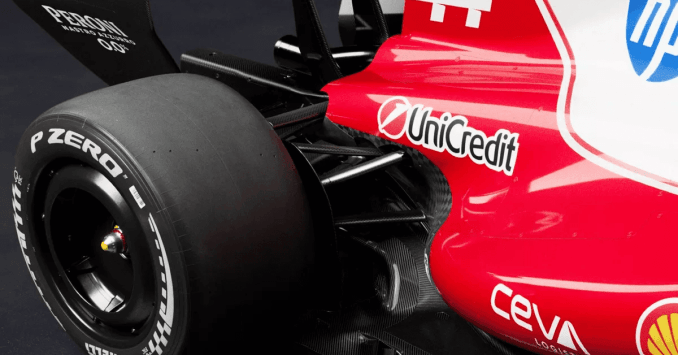
Scuderia Ferrari has pulled the covers off its SF-26 challenger, revealing a car packed with daring technical solutions designed to propel Lewis Hamilton and Charles Leclerc back to the forefront of Formula 1 competition. The first single-seater developed under Technical Director Loic Serra's leadership represents a complete reset from previous designs, adapting to Formula 1's new regulations that mandate shorter, narrower, and lighter cars with revolutionary power units.
The SF-26 immediately distinguishes itself with a push-rod front suspension layout featuring an innovative bracket system and a multi-link rear setup. This marks a decisive break from Ferrari's recent pull-rod approach, acknowledging that ground-effect aerodynamic advantages that justified that configuration no longer exist under the updated technical regulations.
At the front, the most striking innovation involves the relocation of the steering arm behind the narrow lower triangle. This concept, initially developed by McLaren and later experimented with by Mercedes, has been fully embraced by Ferrari's engineering team. The design pushes the front wheels forward to increase distance from the sidepods, helping to clean up airflow in the car's wake.
The nose section shows careful aerodynamic consideration, sculpted underneath to channel central airflow guided by two prominent pylons that support the front wing. These pylons integrate directly into the nose, which extends almost to the main profile. A lower hump houses the hydraulic mechanism for the two movable flaps, though Ferrari's implementation appears less conspicuous than designs seen on other 2026 cars.
Ferrari's technical approach shows clear influences from rival teams, with notable similarities to Mercedes' W17 choices and McLaren's suspension extremes. The upper triangle appears very open with one arm anchored to the top of the chassis, while the rear arm—covered with a curved shroud—is sharply angled, following concepts pioneered by McLaren.
To meet the challenging 678 kg minimum weight requirement including driver, Ferrari opted for a wheelbase slightly shorter than the maximum permitted 3,400 mm, potentially around 50 mm under the limit. This decision saves approximately 1.5 kg while optimizing balance with the car's smaller overall dimensions. The fuel tank capacity has been reduced to under 100 kg from 110 kg last year, reflecting the new power unit requirements that balance thermal and electric power.
The livery presents a brilliant red complemented by white portions that evoke memories of the legendary 312T rather than more recent designs. While this initial version represents the base car that will undergo evaluation during Barcelona testing, the final specification that races in Melbourne will feature evolution packages currently under development by the aerodynamics team led by Diego Tondi.
Ferrari's willingness to embrace concepts from rival teams demonstrates the Scuderia's determination to return to winning ways after several challenging seasons. The SF-26 represents the foundation upon which Ferrari hopes to build its championship challenge, with all eyes now turning to how these bold technical innovations will perform when testing begins.
Source: scuderiafans.com